Annual Reports
PT Trimegah Bangun Persada Tbk's annual reports contain management's most considered account of the business. These are the sections, passages and visual pages worth opening in the originals preserved in Sources.
PT Trimegah Bangun Persada Tbk (Harita Nickel) — 2025 Annual Report — FY2025
Latest edition: first full year with the KPS smelter and ONC refinery running, and the year associate earnings reached a third of profit. · Open the full document →
Laporan Direksi / The Board of Directors Report — p. 38 · Read the full section →
Management's own account of the year: volumes by ore type and product, and why FeNi and MHP margins behave differently.
2025 volumes: 30.59m wmt of ore, 188,581t Ni in FeNi, and installed capacity by route.
From a mining perspective, the Company recorded total nickel ore sales volume of 30.59 million wmt, representing a 28.8% increase compared to the previous year. This growth was largely driven by a significant sales of saprolite ore, which reached 12.09 million wmt, in line with higher demand from RKEF smelters, particularly following the commencement of operations at PT KPS. Meanwhile, limonite ore sales reached 18.50 million wmt, supported by feedstock requirements for HPAL facilities, including the full-year contribution from PT ONC. […] In the RKEF segment, through PT MSP, PT HJF, and PT KPS, the Company achieved an installed capacity of approximately 240,000 tons of nickel metal per year, with additional significant capacity contribution from PT KPS, which has operated 8 (eight) production lines. Correspondingly, FeNi sales volume in 2025 reached 188,581 tons of nickel content in FeNi, compared to 126,344 tons of nickel content in FeNi from previous year. […] On the other hand, in the HPAL segment, the Company, through PT HPL and PT ONC, recorded an installed capacity of approximately 120,000 tons of nickel-cobalt metal per year. […] From a profitability perspective, these two segments exhibit distinct yet complementary margin characteristics. The RKEF (FeNi) segment, which is based on saprolite ore, generally has a more stable and relatively lower cost structure, serving as a margin stabilizer under pressured pricing conditions.
p. 42 · Read in context →
Why the two processing routes are run as a pair: FeNi for stability, MHP for cobalt credits and mix.
Meanwhile, the HPAL (MHP) segment provides exposure to higher value-added products, particularly within the EV battery supply chain. Although the HPAL cost structure is relatively more complex and sensitive to input price fluctuations such as sulfur, the segment benefits from cobalt by-product credits, which, under certain price conditions, help offset cost pressures and sustain competitive margins. […] Therefore, the Company’s portfolio mix of FeNi and MHP provides a balance between short-term cash flow stability and long-term margin expansion potential. In a volatile market environment, this strategy enables the Company to maintain profitability while remaining wellpositioned in structurally growing segments of the global nickel industry.
p. 43 · Read in context →
Struktur Korporasi / Corporate Structure — p. 96 · Read the full section →
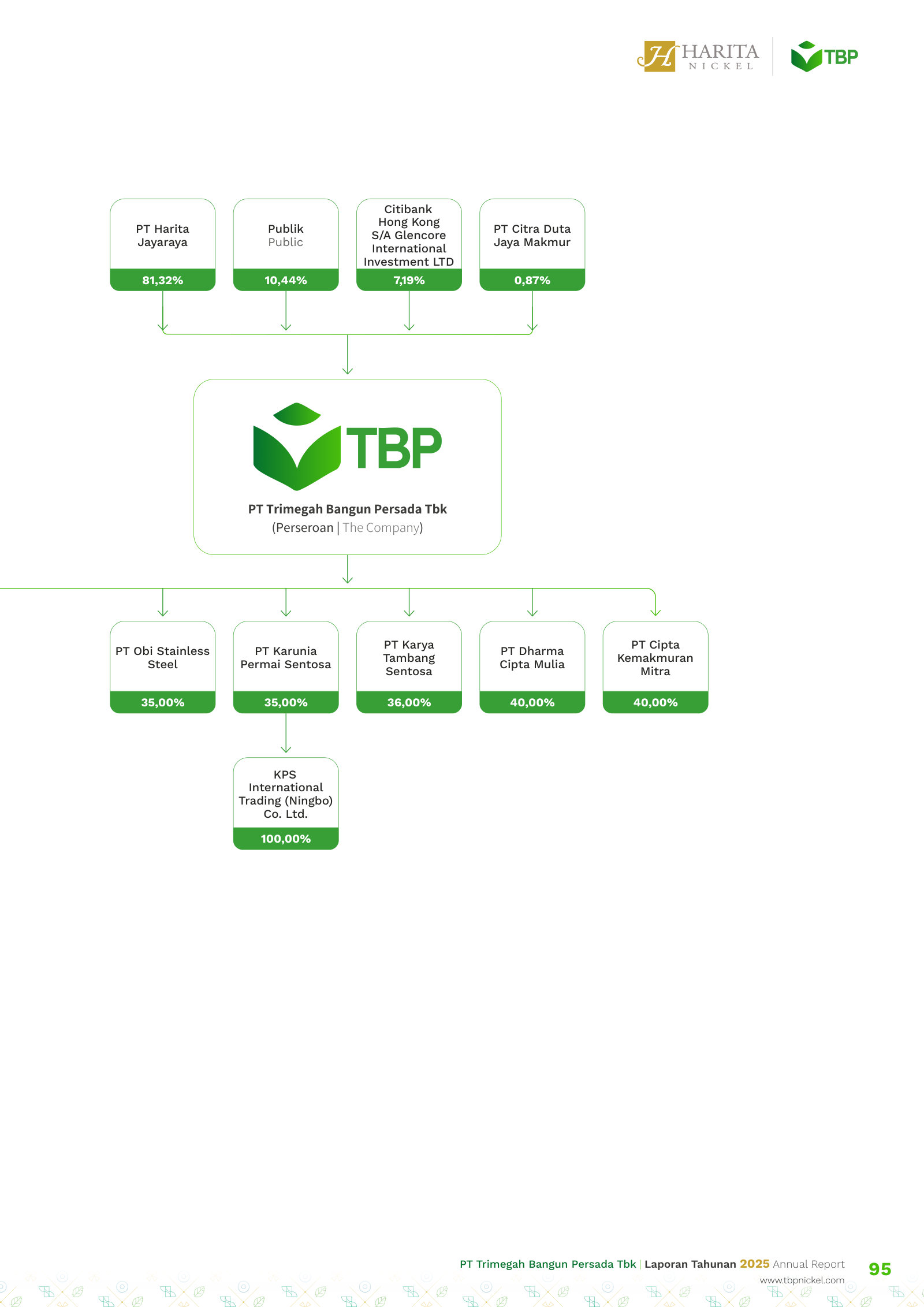
Shows what the income statement does not: Harita holds 81.3%, Glencore 7.2%, and the HPAL plants are minority stakes.
Tinjauan Kondisi Eksternal / View on External Conditions — p. 104 · Read the full section →
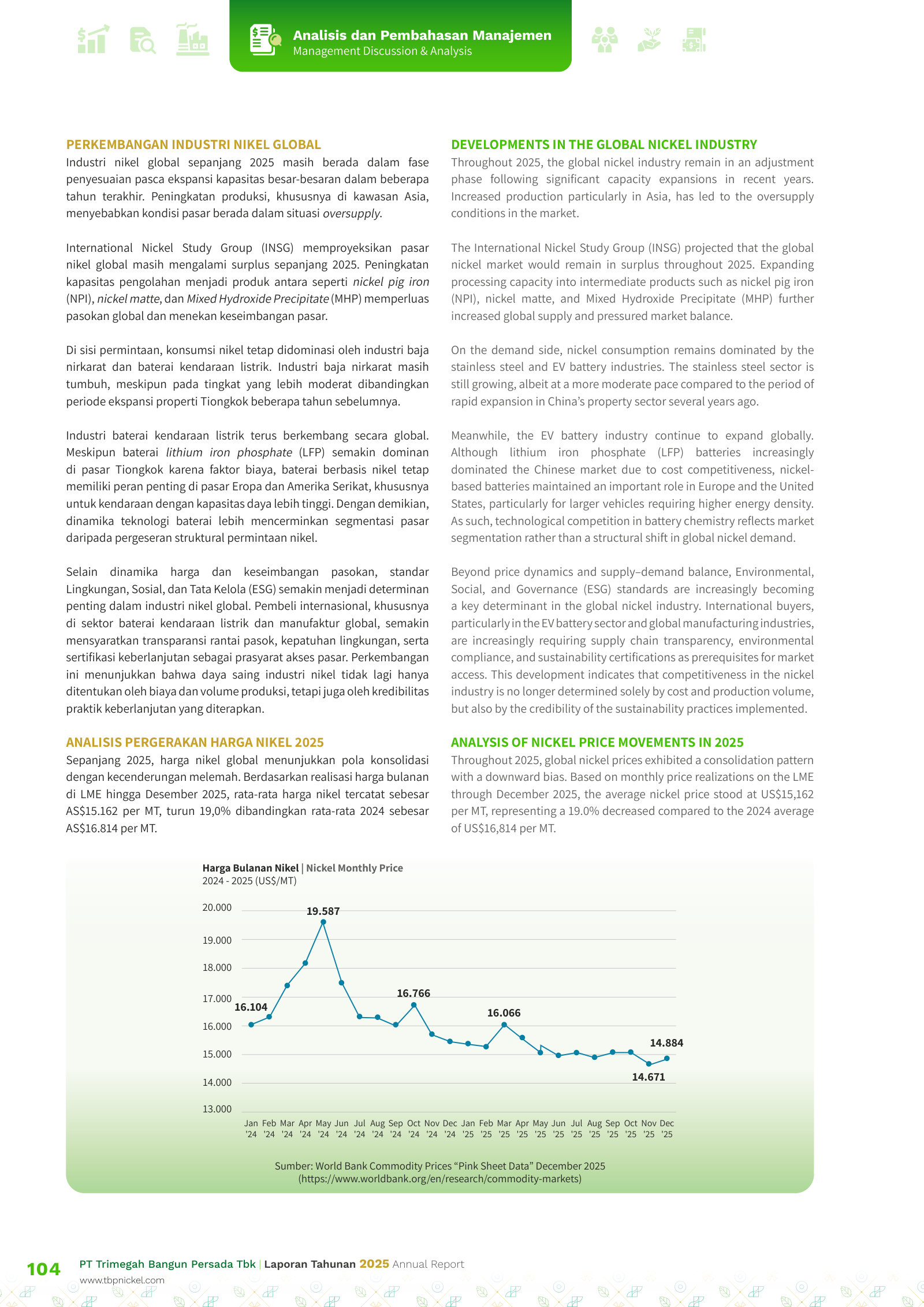
The price backdrop the whole year is judged against — a third year of surplus and a 19% lower average LME price.
Tinjauan Kinerja Operasional / Operational Performance Review — p. 108 · Read the full section →
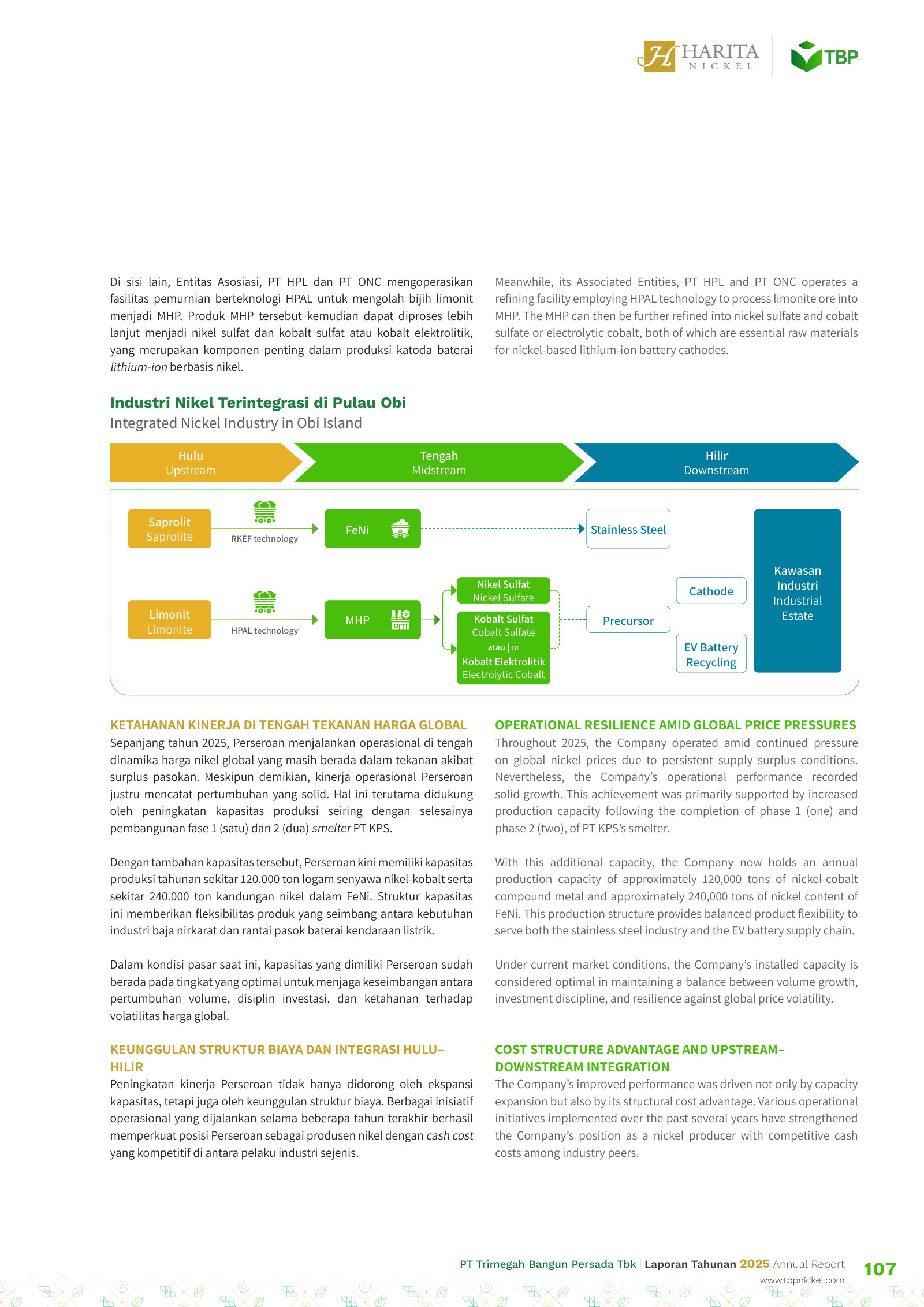
The clearest statement of how the business actually works: two ore types, two technologies, one island.
Limonite and saprolite, RKEF and HPAL, and why co-location on Obi Island matters.
The Company operates an integrated nickel business model spanning mining through processing activities. Its primary products are derived from laterite nickel ore, which consists of two main types: limonite and saprolite. Limonite ore typically contains approximately 1.1%–1.2% nickel content and is located closer to the surface. Beneath this layer lies saprolite ore, which generally contains higher nickel grades. […] All mined ore, both limonite and saprolite, were processed at downstream facilities owned by the Company’s Subsidiaries and Associated Entities located on Obi Island. The integration of mining sites and processing facilities within a single industrial cluster provides operational advantages, particularly in terms of logistics efficiency and supply reliability. […] Through its Subsidiaries, PT MSP, PT HJF, and Associated Entity, PT KPS, the Company operates smelter utilizing Rotary Kiln Electric Furnace (RKEF) technology to process saprolite ore into ferronickel (FeNi), which is subsequently used as a key raw material in stainless steel production.
p. 108 · Read in context →
Tinjauan Keuangan / Financial Overview — p. 118 · Read the full section →
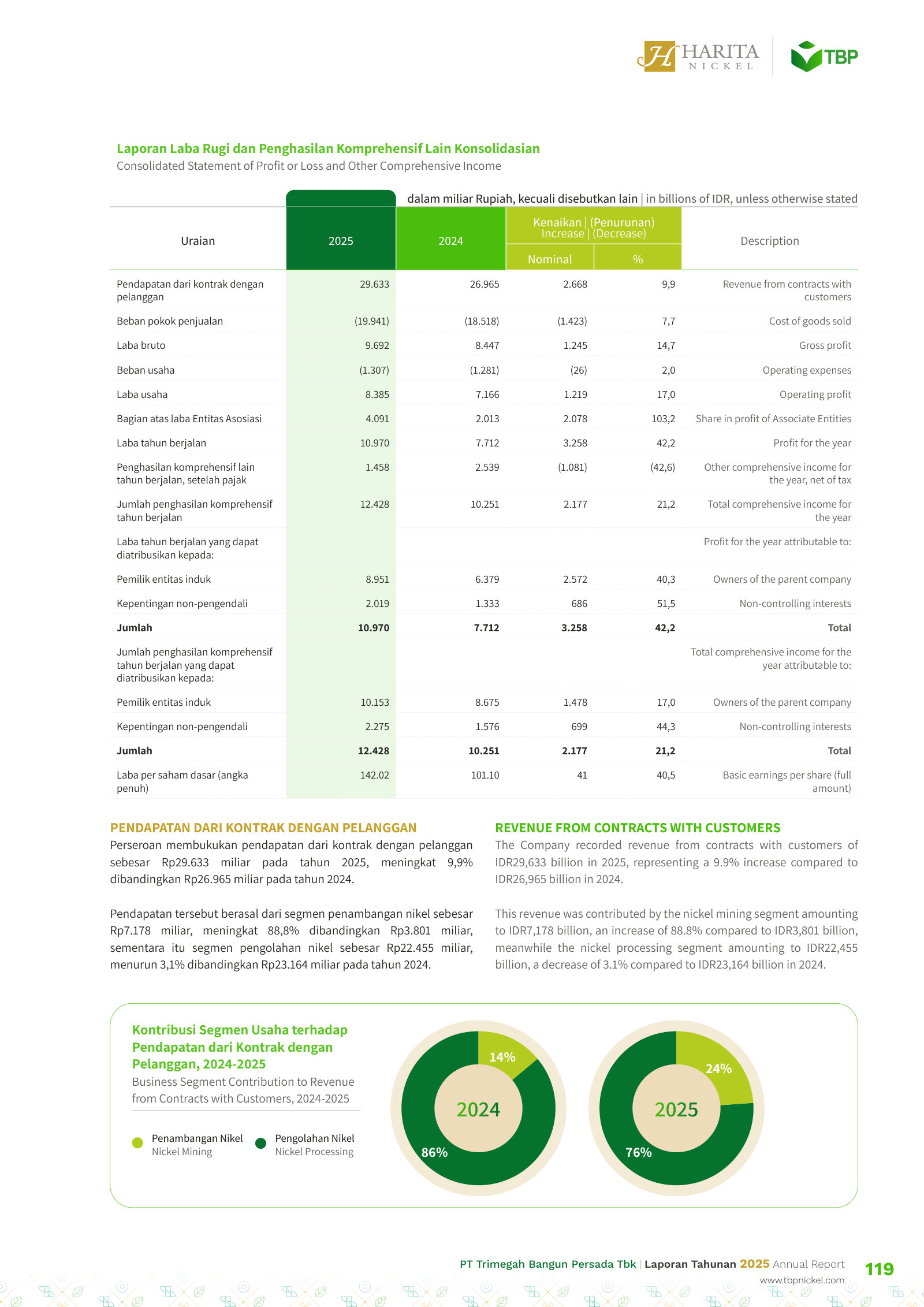
Where the growth came from: mining segment revenue up 88.8% while processing revenue fell, and associate profit doubled.
FY2025 revenue split: nickel mining IDR7,178bn (+88.8%), nickel processing IDR22,455bn (-3.1%).
The Company recorded revenue from contracts with customers of IDR29,633 billion in 2025, representing a 9.9% increase compared to IDR26,965 billion in 2024.
This revenue was contributed by the nickel mining segment amounting to IDR7,178 billion, an increase of 88.8% compared to IDR3,801 billion, meanwhile the nickel processing segment amounting to IDR22,455 billion, a decrease of 3.1% compared to IDR23,164 billion in 2024.
p. 121 · Read in context →
Manajemen Risiko / Risk Management — p. 208 · Read the full section →
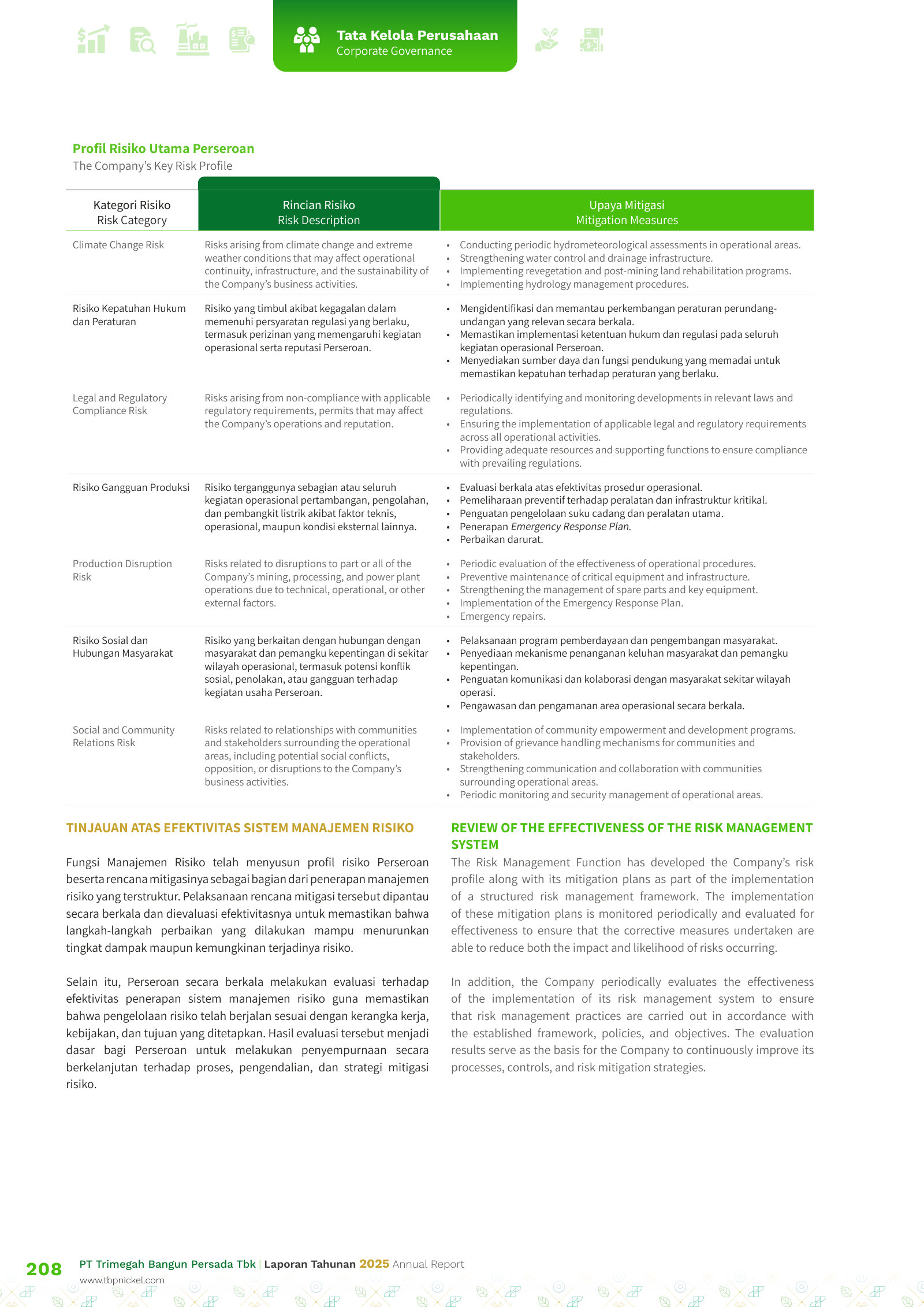
The only risk disclosure in the report; the production-disruption and community rows are the ones tied to a single-island operation.
Catatan 10. Investasi pada Entitas Asosiasi / Note 10. Investment in Associates — p. 343 · Read the full section →
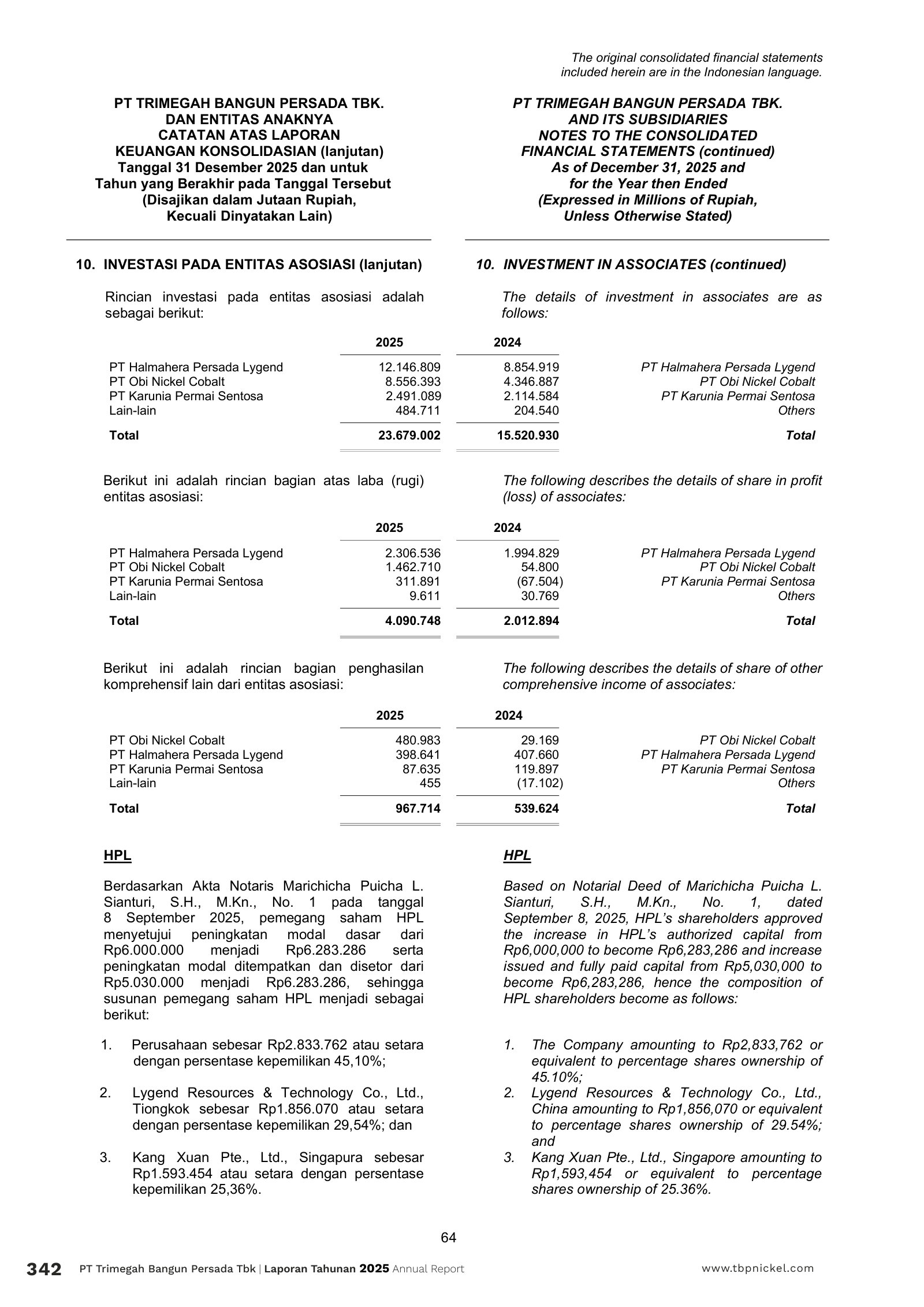
The structural fact of NCKL: the HPAL refineries are 45.1%/40% associates, equity-accounted and absent from revenue.
HPL, ONC and KPS are private, unquoted and carried on the equity method.
The material associates of the Group are HPL, ONC and KPS. All associates are private companies in which there are no quoted market share prices available. The Group’s interests in all associated are accounted for using the equity method in the consolidated financial statements.
p. 343 · Read in context →
Catatan 37. Informasi Segmen / Note 37. Segment Information — p. 395 · Read the full section →
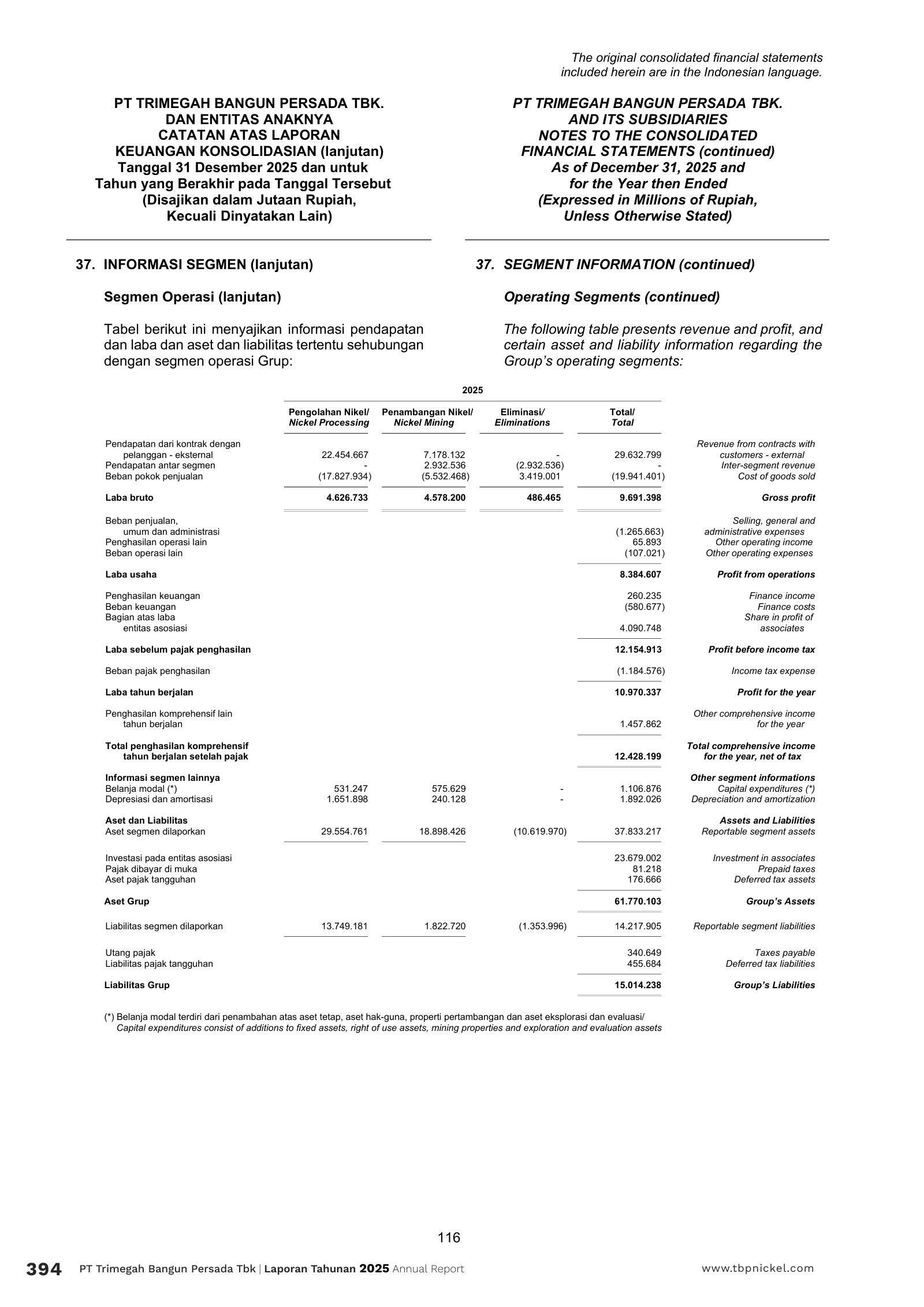
Defines the two reportable segments and shows that associate profit and the IDR23.7tn investment sit outside both.
Two reportable segments; financing and tax are managed group-wide and not allocated.
For management purposes, the Group is organized into business units based on their products and services and has two reportable operating segments as follows: […] Management monitors the operating results of its business units separately for the purpose of making decisions about resource allocation and performance assessment. Segment performance is evaluated based on operating profit or loss and is measured consistently with operating profit or loss in the consolidated financial statements. However, the Group financing (including finance costs and finance income) and income taxes are managed on a group basis and are not allocated to operating segments.
p. 395 · Read in context →
PT Trimegah Bangun Persada Tbk (Harita Nickel) — 2023 Annual Report — FY2023
The first post-IPO edition, whose business chapter is written at half today's capacity and before ONC and KPS existed as associates. · Open the full document →
Tinjauan Segmen Usaha / Business Segment Review — p. 101 · Read the full section →
How the company framed itself in 2023 — mining plus an industrial estate, two active pits, 301.9m wmt of reserves and resources.
2023 framing: two segments, two producing concessions, 301.9m wmt versus 310.8m wmt in 2025.
The Company operates 2 (two) main segments, namely nickel ore mining and establishment as well as the operation of an industrial estate on Obi Island, North Maluku Province. […] The Company estimates nickel ore reserves approximately 301.9 million wet metric tons (wmt) from 2 (two) active nickel laterite mining projects originating from the concessions of PT Trimegah Bangun Persada Tbk (“PT TBP”) and PT Gane Permai Sentosa (“PT GPS”), and 2 (two) mining concessions for nickel mining prospectus namely PT Jikodolong Megah Pertiwi (“PT JMP”) and PT Gane Tambang Sentosa (“PT GTS”).
p. 101 · Read in context →
Keunggulan Kompetitif / Competitive Advantages — p. 102 · Read the full section →
The technical explanation of RKEF and HPAL that later editions dropped, with the capacity base that has since roughly doubled.
End-2023 HPAL base: three lines, 55,000t MHP a year — against 120,000t of nickel-cobalt metal in 2025.
The Company is the first to develop and operate a refinery using HPAL technology in Indonesia, boasting the world’s largest capacity for nickel and cobalt production. […] The Company has an HPAL refinery through investment in PT Halmahera Persada Lygend (“PT HPL”) which has 3 (three) production lines with a total capacity of 55,000 tons of MHP per year produced from raw materials of 7.7 million wmt limonite.
p. 104 · Read in context →
More annual reports
PT Trimegah Bangun Persada Tbk (Harita Nickel) — 2024 Annual Report — FY2024 · 446 pages · The year ONC started up and NCKL took its stake to 20%, moving the second HPAL plant onto the equity method. · Open →
PT Trimegah Bangun Persada Tbk (Harita Nickel) — 2022 Annual Report — FY2022 · 410 pages · First annual report, covering the pre-IPO year and the common-control reorganisation that assembled the group. · Open →